Foreign Direct Investment (FDI)
Global Markets Analyst
Foreign Direct Investment (FDI) is a category of cross-border investment in which an investor resident in one economy establishes a lasting interest in and a significant degree of influence over an enterprise resident in another economy. The standard threshold for this 'lasting interest' is typically the ownership of 10% or more of the voting power in the enterprise.
FDI is a critical driver of economic growth, providing not just capital but also technology transfer, managerial expertise, and access to global supply chains. However, for investors, it requires a deep understanding of local regulatory environments, geopolitical risks, and the long-term sustainability of the host economy's infrastructure.
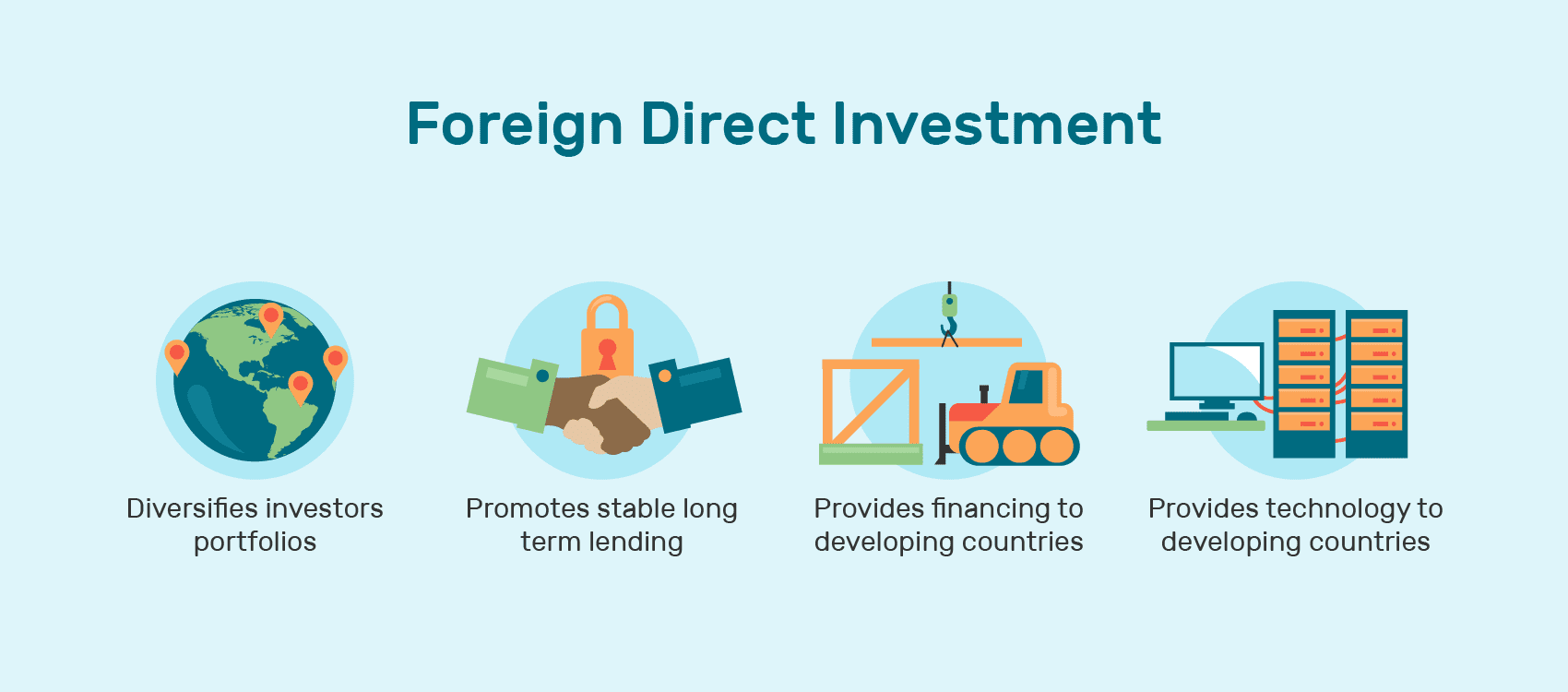
The Four Modalities of FDI
Horizontal FDI involves expanding the same business operations to a foreign country. This is primarily a market-seeking strategy, aimed at bypassing trade barriers or reducing transport costs.
Vertical FDI (both forward and backward) is about supply chain optimization. By owning the source of raw materials or the distribution network in a foreign market, companies can achieve unmatched operational control.
FDI is the ultimate commitment to a market. It transforms a company from a remote participant into a central stakeholder in a nation's economic future. We provide the intelligence to ensure your 'lasting interest' is backed by resilient structures.
1What is Foreign Direct Investment (FDI)?
- Foreign direct investment (FDI) is an investment from a party in one country into a business or corporation in another country with the intention of establishing a lasting interest. Lasting interest differentiates FDI from foreign portfolio investments, where investors passively hold securities from a foreign country. A foreign direct investment can be made by obtaining a lasting interest or by expanding one’s business into a foreign country.
2Lasting Interest and the Element of Control
- An investment into a foreign firm is considered an FDI if it establishes a lasting interest. A lasting interest is established when an investor obtains at least 10% of the voting power in a firm.
- The key to foreign direct investment is the element of control. Control represents the intent to actively manage and influence a foreign firm’s operations. This is the major differentiating factor between FDI and a passive foreign portfolio investment.
- For this reason, a 10% stake in the foreign company’s voting stock is necessary to define FDI. However, there are cases where this criterion is not always applied. For example, it is possible to exert control over more widely traded firms despite owning a smaller percentage of voting stock.
3Methods of Foreign Direct Investment
- As mentioned above, an investor can make a foreign direct investment by expanding their business in a foreign country. Amazon opening a new headquarters in Vancouver, Canada would be an example of this.
- Reinvesting profits from overseas operations, as well as intra-company loans to overseas subsidiaries, are also considered foreign direct investments.
- Finally, there are multiple methods for a domestic investor to acquire voting power in a foreign company. Below are some examples:
- Methods
- ·Acquiring voting stock in a foreign company
- ·Mergers and acquisitions
- ·Joint ventures with foreign corporations
- ·Starting a subsidiary of a domestic firm in a foreign country
4Benefits of Foreign Direct Investment
- Foreign direct investment offers advantages to both the investor and the foreign host country. These incentives encourage both parties to engage in and allow FDI.
- Benefits for businesses:
- ·Market diversification
- ·Tax incentives
- ·Lower labor costs
- ·Preferential tariffs
- ·Subsidies
- Benefits for the host country:
- ·Economic stimulation
- ·Development of human capital
- ·Increase in employment
- ·Access to management expertise, skills, and technology
- For businesses, most of these benefits are based on cost-cutting and lowering risk. For host countries, the benefits are mainly economic.
5Types and Examples of Foreign Direct Investment
- Typically, there are two main types of FDI: horizontal and vertical FDI.
- Horizontal
- ·A business expands its domestic operations to a foreign country. In this case, the business conducts the same activities but in a foreign country. For example, McDonald’s opening restaurants in Japan would be considered horizontal FDI.
- Vertical
- ·A business expands into a foreign country by moving to a different level of the supply chain. In other words, a firm conducts different activities abroad but these activities are still related to the main business. Using the same example, McDonald’s could purchase a large-scale farm in Canada to produce meat for their restaurants.
- However, two other forms of FDI have also been observed: conglomerate and platform FDI.
- Conglomerate
- ·A business acquires an unrelated business in a foreign country. This is uncommon, as it requires overcoming two barriers to entry: entering a foreign country and entering a new industry or market. An example of this would be if Virgin Group, which is based in the United Kingdom, acquired a clothing line in France.
- Platform
- ·A business expands into a foreign country but the output from the foreign operations is exported to a third country. This is also referred to as export-platform FDI. Platform FDI commonly happens in low-cost locations inside free-trade areas. For example, if Ford purchased manufacturing plants in Ireland with the primary purpose of exporting cars to other countries in the EU.
Key Analysis Themes
Strategic Takeaway
FDI Impact Index
Global Challenges
- 01Navigating protectionist policies and local content requirements
- 02Managing currency risk and repatriation of profits
- 03Aligning corporate governance standards across different legal systems
- 04Mitigating political instability and expropriation risks
Expert Advisory
Navigate complex trade corridors with institutional-grade intelligence and tactical execution.
Schedule BriefingKey Analysis Themes
FDI Impact Index
Global Challenges
- 01Navigating protectionist policies and local content requirements
- 02Managing currency risk and repatriation of profits
- 03Aligning corporate governance standards across different legal systems
- 04Mitigating political instability and expropriation risks
Expert Advisory
Navigate complex trade corridors with institutional-grade intelligence and tactical execution.
Schedule BriefingKey Analysis Themes
FDI Impact Index
Global Challenges
- 01Navigating protectionist policies and local content requirements
- 02Managing currency risk and repatriation of profits
- 03Aligning corporate governance standards across different legal systems
- 04Mitigating political instability and expropriation risks
Expert Advisory
Navigate complex trade corridors with institutional-grade intelligence and tactical execution.
Schedule Briefing