Free on Board (FOB)
Logistics Intelligence Lead
Free on Board (FOB) is one of the most critical Incoterms in international trade. It defines the exact moment when the risk of loss or damage to goods transfers from the seller to the buyer. Specifically, under FOB terms, the seller is responsible for the goods until they are loaded 'on board' the shipping vessel at the designated port of origin.
Misunderstanding FOB terms can lead to significant financial loss and legal disputes. It affects everything from marine insurance premiums to the timing of revenue recognition on a company's balance sheet. A clear agreement on FOB Origin vs. FOB Destination is the foundation of a resilient supply chain.
FOB Origin vs. FOB Destination
Under FOB Origin (or FOB Shipping Point), the buyer takes ownership the second the goods are loaded at the factory or warehouse. This means the buyer is responsible for all shipping costs and bears the risk of any transit damage.
FOB Destination shifts the burden to the seller until the goods reach the buyer's doorstep. While this is more convenient for the buyer, it often results in higher 'all-in' pricing as the seller must price in the insurance and freight risks.
Precision in shipping terms is not just a legal requirement; it is a tactical advantage. By optimizing FOB agreements, companies can reduce their 'landed cost' and gain greater control over their global inventory flow.
1What is Free on Board (FOB)?
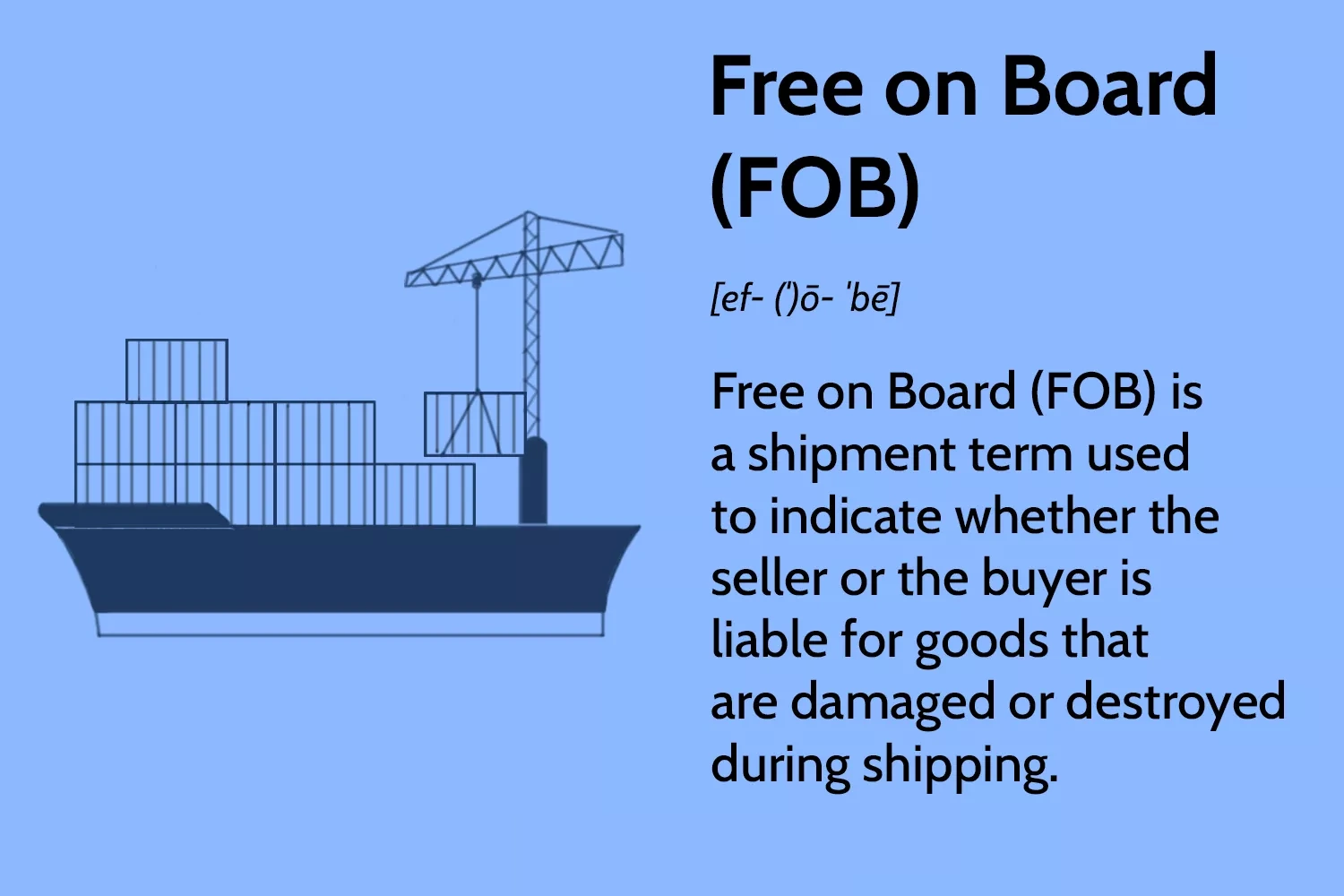
- Free on Board (FOB) is a shipment term that defines the point in the supply chain when a buyer or seller becomes liable for the goods being transported. Purchase orders between buyers and sellers specify the FOB terms and help determine ownership, risk, and transportation costs.
- “FOB Origin” or FOB Shipping Point” means the buyer accepts the title of the goods at the shipment point and assumes all risk once the seller ships the product. The buyer is responsible if the goods are damaged or lost while in transit.
- “FOB Destination” means the seller retains the title of the goods and all responsibility during transit until the items reach the buyer.
2KEY TAKEAWAYS
- Key Insights
- ·Free on Board (FOB) is a term used to indicate when the ownership of goods transfers from buyer to seller and who is liable for goods damaged or destroyed during shipping.
- ·“FOB Origin” means the buyer assumes all risk once the seller ships the product.
- ·“FOB Destination” means the seller retains the risk of loss until the goods reach the buyer.
- ·FOB terms can impact inventory, shipping, and insurance costs.
3Understanding Free on Board (FOB)
- FOB is a common term used for all types of shipping, both domestic and international. Shipping orders and contracts often describe the time and place of delivery, payment, when the risk of loss shifts from the seller to the buyer, and which party pays the costs of freight and insurance.
- The vendor-client transaction defines the FOB terms in the purchase order. FOB status does not determine ownership, which is determined in the bill of sale or agreement between the buyer and seller, but defines which party takes responsibility for the shipment, whether at Origin, where the shipment begins or at Destination, where the shipment ends.
- Each party should have a firm understanding of free on board (FOB) to ensure a smooth transfer of goods from the vendor to the client. Regardless of whether that transfer occurs on the domestic or international level, FOB terms can impact inventory, shipping, and insurance costs.
4FOB Origin vs. FOB Destination
- FOB origin, or shipping point, means that the buyer will receive the title for the goods they purchased when shipment begins. The seller’s responsibility ends when the items are placed with a shipment carrier, and the buyer must ensure their goods reach their final destination on time and undamaged.
- For FOB destination, the seller retains ownership of the goods and is responsible for replacing damaged or lost items until the point where the goods have reached their final destination.
- For shipments internationally, especially for companies ordering large inventory for global shipment on vessels and containers, international contracts establish and outline provisions, including the time and place of delivery, payment terms, and FOB designation to define when the risk of loss shifts from the seller to the buyer and which party pays for freight and insurance.
- The most common international trade terms are Incoterms, which the International Chamber of Commerce (ICC) publishes, but firms that ship goods within the U.S. must adhere to the Uniform Commercial Code (UCC).
- Since there is more than one set of rules, and legal definitions of FOB may differ from one country to another, the parties to a contract must indicate which governing laws are being used for a shipment.
5FOB and Company Accounting
- For FOB origin, after the goods are placed with a carrier for transport, the company records an increase in its inventory and the seller records the sale at the same time.
- For FOB destination the seller completes the sale in its records once the goods arrive at their final destination and the buyer records the increase in its inventory at that time.
6Other Shipping Terms
- Although FOB Origin and Destination are the most familiar shipping terms, other terms include:
- Common Incoterms
- ·FAS or Free Alongside: The seller must deliver goods on a ship that pulls up alongside a ship and close enough that the ship can use its lifting devices to bring the goods aboard.
- ·FCA or Free Carrier: The seller is obligated to deliver goods to an airport, shipping port, or railway terminal where the buyer has an established place of operation and takes delivery there.
- ·EXW or Ex Works: The seller prepares items for shipment from its location, but the buyer is responsible for picking the goods up and arranging shipment.
- ·DES or Delivered Ex Ship: The seller delivers products to a specified shipping port, where the buyer will take delivery on arrival.
7What Is FOB Pricing?
- The costs associated with FOB can include transportation of the goods to the port of shipment, loading the goods onto the shipping vessel, freight transport, insurance, and unloading and transporting the goods from the arrival port to the final destination.
8Who Pays Freight for FOB Origin?
- If the terms include the phrase “FOB origin, freight collect,” the buyer is responsible for freight charges. If the terms include “FOB origin, freight prepaid,” the buyer assumes the responsibility for goods at the point of origin, but the seller pays the cost of shipping.
9What Is the Difference Between FOB and CIF?
- CIF (Cost, Insurance, and Freight) and FOB (Free on Board) are two widely used INCOTERM agreements. Although the definition of both terms can differ across countries and is ultimately determined by each vendor-client contract, historically, FOB transfers liability from seller to buyer when the shipment reaches the port or other facility designated as the point of origin. With a CIF agreement, the seller pays costs and assumes liability until the goods reach the port of destination chosen by the buyer.
10The Bottom Line
- Free on Board (FOB) is a shipment term that defines the point in the supply chain when a buyer or seller assumes responsibility for the goods being transported. FOB terms like FOB Origin and FOB Destination help define ownership, risk, and transportation costs for both buyers and sellers.
Key Analysis Themes
Strategic Takeaway
Logistics Risk Assessment
Global Challenges
- 01Clarifying the technical 'ship's rail' boundary for risk transfer
- 02Managing insurance coverage gaps during vessel loading
- 03Navigating disparate port customs and loading procedures
- 04Aligning accounting practices with physical ownership transfer
Expert Advisory
Navigate complex trade corridors with institutional-grade intelligence and tactical execution.
Schedule BriefingKey Analysis Themes
Logistics Risk Assessment
Global Challenges
- 01Clarifying the technical 'ship's rail' boundary for risk transfer
- 02Managing insurance coverage gaps during vessel loading
- 03Navigating disparate port customs and loading procedures
- 04Aligning accounting practices with physical ownership transfer
Expert Advisory
Navigate complex trade corridors with institutional-grade intelligence and tactical execution.
Schedule BriefingKey Analysis Themes
Logistics Risk Assessment
Global Challenges
- 01Clarifying the technical 'ship's rail' boundary for risk transfer
- 02Managing insurance coverage gaps during vessel loading
- 03Navigating disparate port customs and loading procedures
- 04Aligning accounting practices with physical ownership transfer
Expert Advisory
Navigate complex trade corridors with institutional-grade intelligence and tactical execution.
Schedule Briefing